What AQL 2.5 actually means for your order
Every activewear factory writes AQL 2.5 on a quotation. Very few explain it. Here is the sample size the standard actually sets, the accept and reject numbers behind it, and what happens when a lot fails.
Ask ten activewear factories for a quotation and nine of them will put the words AQL 2.5 somewhere near the bottom. It reassures buyers, it costs nothing to type, and almost nobody is asked to explain it. That is a problem, because AQL is not a promise about quality — it is a published sampling procedure, and the procedure only protects you if both sides know which numbers it produces for your order quantity.
This is how it works on our floor in Tong’an, Xiamen, written out in full so you can hold any supplier to the same standard.
AQL is a sampling standard, not a quality grade
AQL stands for Acceptable Quality Limit. The version used across apparel is ANSI/ASQ Z1.4 (the descendant of MIL-STD-105E, and effectively identical to ISO 2859-1), read at general inspection level II. The standard does two things: it tells you how many garments to pull from a finished lot, and it tells you how many defects in that sample mean the lot passes or fails.
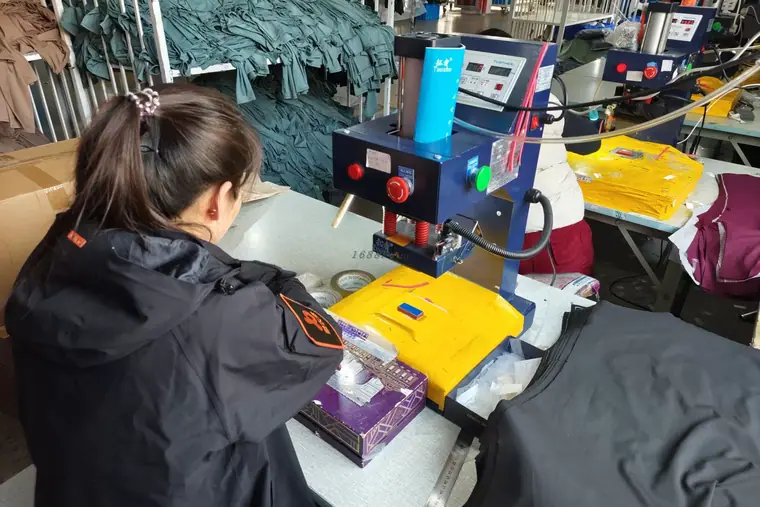
What it does not do is describe the garment. A leggings program can be inspected at AQL 2.5 and still be a bad legging — if the fabric was never tested, if the fit was never graded properly, or if the defect list the inspector works from is vague. AQL is the last gate, not the whole system. On our line it sits behind four earlier checkpoints: incoming fabric, cutting audit, in-line roving QC, and 100% end-line inspection of every single garment.
A random sample, not a spot check
Cartons are pulled at random from across the finished lot — not from the top of the pallet, and not from a set the factory has had time to prepare. The sample size is fixed by the standard from your order quantity, so neither side gets to choose it. That is the entire point of using a published standard: the arithmetic is not negotiable at the moment of the argument.
Sample size and accept/reject numbers
These are the numbers for general inspection level II at AQL 2.5, which is the normal apparel standard for major defects.
| Your order quantity | Garments inspected | Accept if majors ≤ | Reject if majors ≥ |
|---|---|---|---|
| 91 – 150 pcs | 20 | 1 | 2 |
| 151 – 280 pcs | 32 | 2 | 3 |
| 281 – 500 pcs | 50 | 3 | 4 |
| 501 – 1,200 pcs | 80 | 5 | 6 |
| 1,201 – 3,200 pcs | 125 | 7 | 8 |
| 3,201 – 10,000 pcs | 200 | 10 | 11 |
| 10,001 – 35,000 pcs | 315 | 14 | 15 |
Read one row and the standard stops being abstract. On a 1,000-piece order the inspector opens 80 garments; five majors and the lot ships, six and it does not. Nothing in that sentence depends on anyone’s mood.
Defects are graded — and the grade decides the tolerance
Every fault found is classed critical, major or minor. The accept and reject numbers above apply to major defects at 2.5, with minor defects judged separately at 4.0. This is the normal apparel convention, and a supplier who quotes “AQL 2.5” without saying which class it applies to has told you very little.
Critical
Unsafe or unsaleable in any market: needle fragments, sharp trims, missing mandatory safety labelling. The accept number is zero at any quantity. That is precisely why every garment goes through a metal detector before it is folded, rather than relying on the sample to find a broken needle. A sampling plan cannot protect you from a hazard that occurs once in a thousand pieces; a 100% scan can.
Major
A defect a customer would return the garment for: a broken or skipped seam, the wrong size on the label, a print off placement, a shade outside the approved range, a measurement outside your graded tolerance. Audited at 2.5.
Minor
Visible to an inspector but unlikely to cause a return: a slightly uneven stitch line, a loose thread end, a faint crease from packing. Audited at 4.0.
What happens when a lot fails
This is the part worth negotiating before you place the order, because it is where suppliers differ far more than they differ on the number 2.5.
If the sample hits the reject number, the lot is 100% re-inspected and reworked at our cost, then re-audited before it is released. We do not ship a failed lot with a discount attached and we do not ask the buyer to absorb it. Your ship date is our problem to protect, not yours — which is also why the four checkpoints ahead of the final audit exist. By the time a lot reaches the AQL table, a failure should be a surprise, and it usually is.
Where AQL quietly goes wrong
- No written defect list. If “major” is not defined garment by garment before sampling, the inspector improvises and the number is meaningless. Your measurement tolerance, your shade band and your placement tolerance belong in the tech pack.
- Inspection before the lot is finished. A sample pulled at 60% completion is not a sample of your shipment. Final random inspection means final.
- A sample the factory picked. Cartons should be selected by the inspector, on the day, from the whole lot.
- Silence about critical defects. If nobody has told you the critical accept number is zero, ask what the metal detection procedure is and whether every piece passes through it.
Asking for a stricter standard
Want tighter than 2.5? Say so before sampling. We run tightened plans — AQL 1.5, or a 100% audit instead of a sample — for buyers whose retail programs demand it, and we quote it in rather than discovering it at the end. Tightening the plan changes the sample size and the accept numbers, and on a large order it changes the inspection hours, so it belongs in the price you agreed rather than in a conversation the week before shipment.
Whatever plan we agree on, the pre-shipment package is the same: the inspection report, the photo report and any lab reports go out with the shipping documents, not weeks later when your broker is already asking.
The short version
AQL 2.5 means a random sample sized by ANSI/ASQ Z1.4 general level II, majors judged at 2.5 and minors at 4.0, critical defects at zero, and rework at the factory’s cost when the numbers say fail. If a supplier can tell you the sample size for your specific quantity without looking it up, you are talking to someone who actually runs the inspection. If they cannot, you are reading a marketing line.
Send us your quantity and your defect list and we will send back the exact sample size, accept and reject numbers your order will be judged on, before you commit to anything.

Put it to the test
on a real order.
Send a tech pack, a sketch or a reference photo. You get a quotation within 24 hours, a sample in days, and the inspection standard written into the order before anything is cut.